Its value is to provide information and technical control during key steps of the surgery. In consultation we specify what can contribute to your prosthesis and what application is available.
References of your articulation to adapt the plan.
Information to adjust decisions while performing the intervention.
Assistance in moving planning to implant placement.
Why evaluate a prosthesis assisted by ROSA?
The position of the components and the balance of the joint are part of the planning of a prosthesis. ROSA offers measurement and assistance tools to work on these aspects with information about your case.
The proposal is to add technical resources to the surgeon's criteria. If you need a prosthetic, I will explain in what steps it could help and if it justifies its use in your intervention.
What ROSA does and who performs the operation
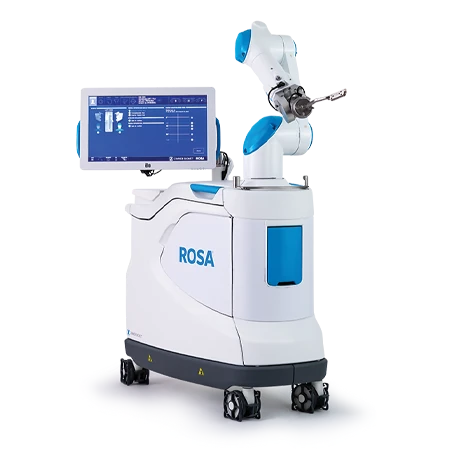
ROSA is a robotic support system: it combines planning, measurements and a robotic arm with specific functions for each procedure. The surgeon interprets the data, decides the position of the components and performs the intervention. The robot does not substitute its criteria or operate autonomously.
ROSA Knee and ROSA Hip are different applications. Their tools, configuration and intervention steps are not interchangeable.
ROSA in the knee prosthesis
In the total knee prosthesis, the system helps record joint references, evaluate their alignment and study the balance of the tissues that stabilize it. With this information, the surgeon can adjust the placement plan of the prosthesis.
The robotic arm helps to place the guidelines for bone cuts according to the plan. The measurements allow to check steps of the intervention; the selection of the implant and the decisions on stability continue to correspond to the surgeon.
ROSA in hip prosthesis
In the hip prosthesis, assistance can help orient the component placed in the pelvis — the cotil — and provide measurements to assess the length of the leg and the relationship between the femur and the pelvis. The technical objective is to transfer the plan to the implant placement with information during the operation.
The approach is chosen individually. The possibilities of assistance depend on the available ROSA application, its authorized indications and the configuration of the center. In consultation, it specifies how the technology fits in with the technique proposed for each patient.

Results of the studies: to find out more
It is important to distinguish technical precision and benefit for the patient. Getting a position closer to the plan does not in itself demonstrate less pain, faster recovery or longer duration of the prosthesis.
On the knee, a randomized ROSA trial published by Möller and collaborators found a better radiological alignment, with clinical improvements similar to those of conventional technique per year. It is a single center and short follow-up study to assess the duration of an implant.
On the hip, a comparative study of a fluoroscopic and tomography-based platform studied mainly the accuracy of cotyl placement. This type of result alone does not allow to conclude that there are fewer complications or fewer long-term reoperations.
The evidence should be interpreted according to the articulation, application of the robot and the technique studied. The results obtained with another system or a different procedure are not automatically transferred to ROSA or to any patient.
When It Can Make Sense
If pain and limitation make it necessary to evaluate a prosthesis, we can also study how to perform it. Anatomy, bone, previous surgeries and the planned implant guide the choice of technique.
Robotic assistance arises when its tools add value to that planning. We will compare the proposal with conventional surgery and resolve your doubts before deciding.
Risks and limitations to be known
The intervention retains the risks inherent to a prosthesis, such as infection, thrombosis, stiffness, damage to nearby structures or persistent pain. The risk of dislocation should also be explained in the hip. Robotic assistance does not eliminate them.
In procedures that use fixed references to the bone, problems can appear at the fixation points, such as infection or fracture. Not all systems and applications use the same references. The team should explain to you which ones will be used in your case.
System preparation, testing and team learning can influence surgical time. If assistance cannot be used safely, the team must have a technical alternative.
Recovery after a robot-assisted prosthesis
Recovery combines pain control, wound care, and progression of mobility and strength. The plan adapts to the intervention and your previous situation.
In consultation we will talk about home support, rehabilitation and return to your activities. guide to preparing for recovery.
Clear Expectations Before Choosing
The technical benefits of robotic assistance do not guarantee less pain, faster recovery or a longer-lasting implant. Outcomes also depend on your condition before surgery, the operation and rehabilitation.
Useful questions for the consultation
- What specific benefit is expected from robotic assistance in my case?
- What ROSA application and what technique are proposed for my prosthesis?
- What imaging tests, bone references, or measurements will be needed?
- What experience does the team have with that procedure and what alternative is there if the robot cannot be used?
- What additional costs can there be and what does my insurer cover?
- What will my rehabilitation be like and who will follow up?
Availability and assessment in Palma de Mallorca
Availability must be confirmed separately for hip and knee. Before you schedule an intervention, the team will explain what application can be used, whether it is suitable for your situation and what it involves in practice.
You can see how preparing an individual assessment. The information on this page describes the technology; it does not itself confirm the availability of all its applications in the center.
Frequently asked questions
Does the robot operate on me alone?
No. The surgeon directs the intervention and makes decisions. ROSA provides assistance and measurements during certain steps.
ROSA is the implanted prosthesis?
No. It is the assistance system used during the operation. The prosthesis is the implant left in the joint; it must be compatible with the procedure and application used.
Will the prosthesis last longer to use a robot?
It cannot be guaranteed. The placement accuracy is a technical result; demonstrating longer duration requires studies with long follow-up.
Does ROSA work the same way for hip and knee surgery?
They are different applications, with their own tools and indications. Availability and convenience should be checked for each intervention.
If you are evaluating a prosthesis, know also the robotic option
We will check whether ROSA brings value in your case, availability for your intervention, and possible additional cost or coverage.
Request a knee replacement assessmentSources for further information
- Zimmer Biomet Europe · ROSA KneeManufacturer: technical operation; no independent evidence of clinical superiority
- Zimmer Biomet Europe · ROSA Hip SystemManufacturer: application and technical functions
- Möller et al. · ROSA Knee versus conventional technique (initial publication 2025)Randomized trial, one center; one-year follow-up
- Ong et al. · Accuracy of two robotic hip platforms (2024)Comparative radiological precision study; no long-term clinical benefit
- Complications of pins according to their diameter in robotic knee arthroplasty (2023)Comparative study; risk context, not specific ROSA rate
- AAOS OrthoInfo · Total hip prosthesisPatient information
- AAOS OrthoInfo · Total knee prosthesisPatient information